Elena Urioste (’08) on Bringing Kaleidoscope Chamber Collective to Curtis

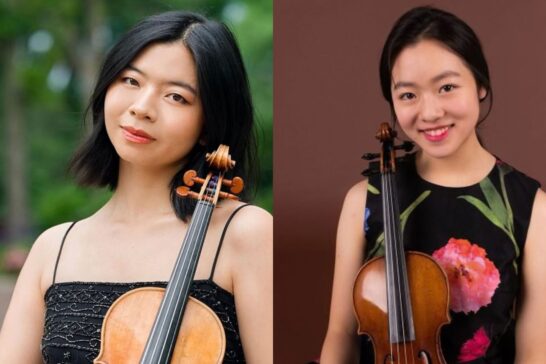
October 26-30, Kaleidoscope Chamber Collective, a U.K.-based ensemble dedicated to celebrating diversity and championing lesser-known repertoire—will bring its distinctive approach to Curtis for a five-day residency—the ensemble’s first at the school. Led by internationally renowned violinist Elena Urioste (’08), violinist Melissa White (’07), and pianist-composer Tom Poster, the residency invites students to explore inclusive programming, arrange their own music, and participate in a special yoga workshop. Students and Kaleidoscope musicians will also present a free, culminating recital on Thursday, October 29 at 7:30 p.m.
We spoke with Urioste, Kaleidoscope’s co-founder and a celebrated writer, yogi, and entrepreneur, about the ensemble’s artistic vision, the importance of broadening classical music’s repertoire, and its residency might inspire Curtis students.
Kaleidoscope Chamber Collective is known for its creative programming and commitment to celebrating diversity in all forms. How have these values shaped your vision for the residency at Curtis and your approach to working with students?
We’ve approached this residency, which feels like a real homecoming of sorts, with the same process and commitment as with any of our projects: a desire to play music we’re excited about with people we adore. We have no doubt that today’s Curtis students are immensely gifted, curious, and hard-working—and reflect the ever-shifting classical music industry in the best possible ways. We are so excited to invite them into our joyful, democratic way of rehearsing, conversing, and performing, and in return are grateful to be invited into their space for our week together.
You’ll be guiding students in inclusive programming and arranging their own music. How do you define inclusive programming—and why is it important in classical music today?
Programming, like food, is most delicious when there are many vibrant ingredients that, when combined thoughtfully, alchemize to create something greater than the sum of their parts. We love our programs to have variety, an overarching shape, and to introduce our listeners to something they may not be familiar with but will hopefully love—and ideally come back for seconds, so to speak! It remains an indisputable fact that the music which turns up on the majority of concert programs represents only a tiny fraction of the great music that has been written over the centuries—so we find particular joy in celebrating the voices which have not been heard as they deserve to be.
What distinguishes Kaleidoscope’s approach to programming and performance?
We often love to feature a different instrumental (or vocal) combination in each piece within a program, build repertoire around creative themes, work with other art forms, and even devise programs that might (for example) follow the arc of a yoga class or draw in an audience of kids. Chamber music programs have, at least until recently, been a rather formulaic affair—and there’s nothing wrong with that, of course, but there are so many other ways to approach programming.
Crucially, we always strive to give the same love and commitment to every piece we play, whether it’s a quintet by Brahms or Beach, a world premiere, or an arrangement of a Gershwin song.
It can take more work to prepare a lesser-known work than a celebrated one. So, it feels particularly meaningful to find the space to let every piece we play shine as it deserves to.
The residency also includes a yoga workshop! What inspired you to include it as part of the programming?
Melissa White (Violin ’07) and I are long-time yoga practitioners, and our many chats about how beneficial a regular practice had become—not only to our moods and lives but to our roles as hard-working, often-traveling violinists—eventually led to founding Intermission, a program that unites movement, mindfulness, breathwork, and music-making. We speak often about how helpful a practice like yoga would have been in our formative years, and we take it upon ourselves to incorporate mindful movement when working with younger musicians. We want to help build strong and malleable foundations for all the incredibly vigorous work we do in order to realize our musical goals.
You’ve described yourselves as “passionate about inspiring the next generation of musicians.” How do you hope your time at Curtis fulfills this mission?
One of the most rewarding things that has happened to us recently is presenters and festivals sharing that they look to Kaleidoscope’s programming to inspire their own. We also get a lot of messages from students saying our outlook has empowered them to program in a more personal and authentic way. It’s a strange and shifting time in the music world (and the world in general), but the more we can encourage our younger colleagues to be free, to be themselves, and to find joy and love in what they do, the richer our global musical community will be.
On Thursday, October 29 at 7:30 p.m., students and Kaleidoscope musicians present a free recital to conclude the residency. RSVP to attend.