Mary Louise Curtis Bok: Beyond the Founder

On Tuesday, October 13, Curtis will release the first-ever biography of the school’s founder, Mary Louise Curtis Bok, as part of its Founder’s Day. Written by Curtis’ senior archivist, Barbara Benedett, and published by Bauer and Dean Publishers, A Practical Philanthropist reveals never-before-published details of this remarkable woman, taking readers on an insightful journey through this special period in the histories of Philadelphia, Curtis, and classical music.
In part one of a two-part series, we offer a glimpse into some of the book’s most remarkable details about Mary—including her integral role in creating Curtis’ curriculum, and how her progressive approach to philanthropy shaped the school’s culture.
Bringing a Vision to Life
Mary brought deep management expertise to her role: For 10 years before founding Curtis, she helped run the Settlement Music School in Philadelphia. At Curtis, she stepped in as acting director two separate times, as well as serving as president of the board.
Her experience at Settlement helped inform her belief that a music school should provide a well-rounded curriculum (not just high-quality lessons), an approach that continues to set Curtis apart to this day.
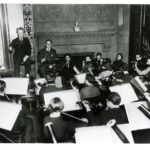
Mary also envisioned employing top-of-the-line musicians as teachers to the school’s aspiring artists. She intentionally leveraged her connections to recruit strong educational leadership, including 20th century greats Isabelle Vengerova, Leopold Stokowski, and Carl Flesch. (Pictured above: Stokowski conducting the Curtis Symphony Orchestra in Curtis’ common room.)
A Practical Philanthropist
As a philanthropist, Mary’s hallmark was addressing everyday barriers that could keep students from succeeding. Her approach, described as “practical philanthropy,” reflected a belief that benefactors should do more than write large donation checks—they should understand and respond to the needs of the people they sought to support.
“Mary and her circle were activist-minded, idealistic people,” says Benedett. “As Philadelphians, so much of what we pass by every day—from the Academy of Music to the Philadelphia Art Museum—was supported by Mary and her family and friends who believed that the fine arts were a positive force in society and belonged to everyone.”
At Curtis, the most consequential example of this was the school’s tuition-free policy for all students. Enacted in 1928, just four years after the school’s founding, the policy meant that admission was based on artistic promise rather than a student’s ability to pay.
Mary’s practical, needs-based approach also included every-day items such as new clothing, automobiles, housing, and even vacations—anything that helped create capacity for students’ artistic growth.
This event includes a light reception at 6:30 p.m., followed by a concert and author’s talk at 7:30 p.m. in Field Concert Hall. Admission is complimentary but requires advance registration.
The publication of A Practical Philanthropist is made possible by the generosity of the Mary Louise Curtis Bok Foundation.